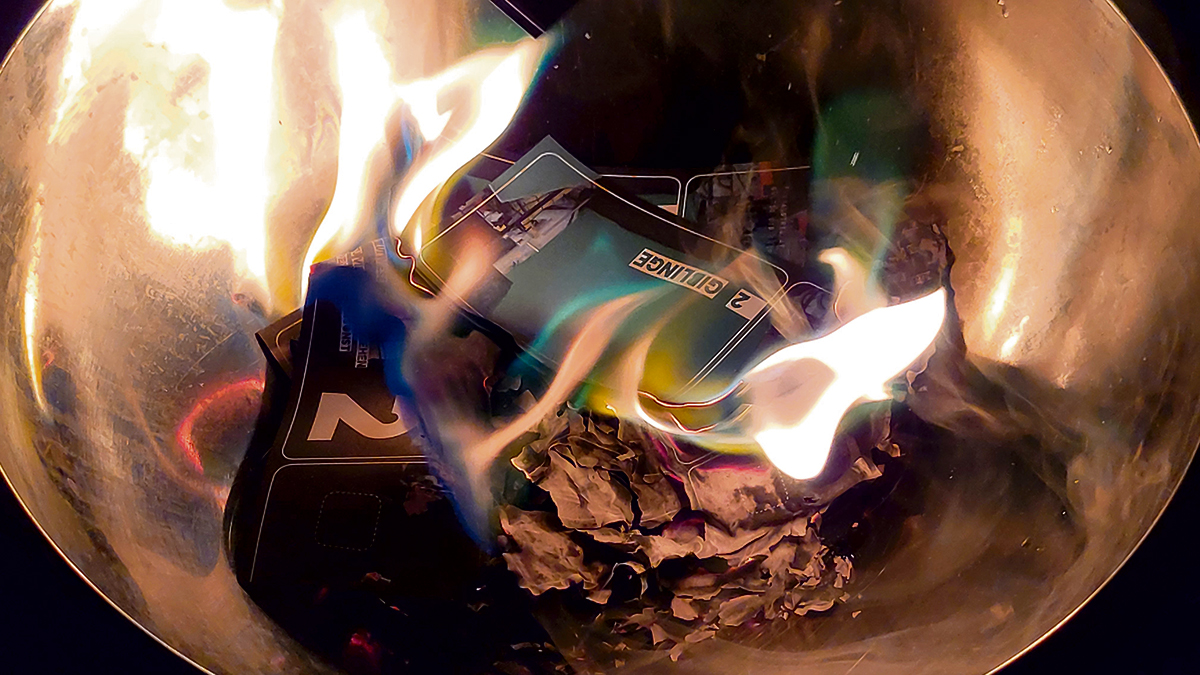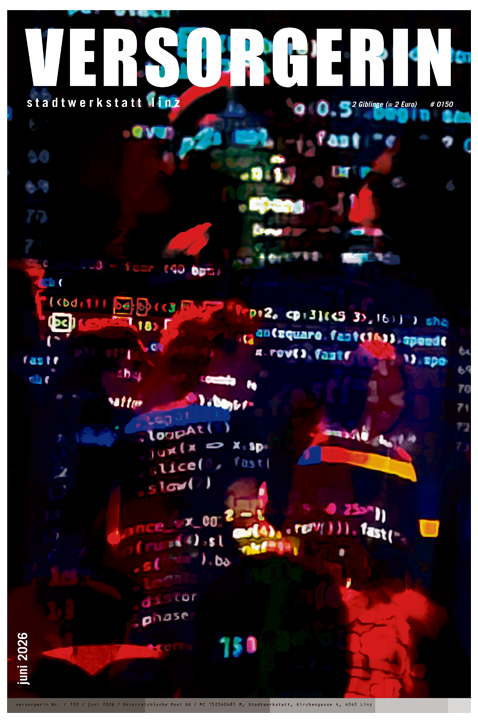
As is well known, the Gibling is the community currency of Punkaustria, the currency institute of the Stadtwerkstatt. And, as is also well known, the bills are redesigned each year by artists. The 15th edition of the community currency GIBLING will once again be valid starting June 15, 2026, following the established schedule. The bills were designed by Stephanie Mercedes and Heike Kaltenbrunner, who are also collaborating on a production of the Gun Destruction Opera Never In Our Image in Linz this September, as part of STWST84x12 HAUNTED.
How did this collaboration between the two come about? Heike Kaltenbrunner, a sound and media artist living in Linz, had shown a work some time ago at the Sound Scene Festival in Washington, D.C. Stephanie Mercedes, an artist based there, approached Heike Kaltenbrunner because Kaltenbrunner’s work incorporated organ pipes—and Mercedes had long wanted to work with them as well. Stephanie Mercedes was already working on Never In Our Image at the time and asked Kaltenbrunner if she had any ideas on how organ pipes might be integrated into her opera. Her opera, Mercedes explained, was primarily an improvised work in which, as part of the “Gun Destruction Opera,” firearms were sawed apart, melted down, and finally recast into new forms—all while queer performers sang, danced, and played music. “Hey,” Heike thought, “we have plenty of weapons here that need to be collected, too.” Consequently, the project made its way to the Stadtwerkstatt. Here is a multi-perspective look at the opera, the banknotes, and the plans—Ralf Petersen asked the questions; the artists answered.
I. MONEY AS A TRAVELING MEDIUM: Every work of art makes use of one or more media. With Gibling, it’s about money, or currency. Art-adorned bills are in circulation, passing through many hands—what factor do you, as artists, see in this journey of the artworks?
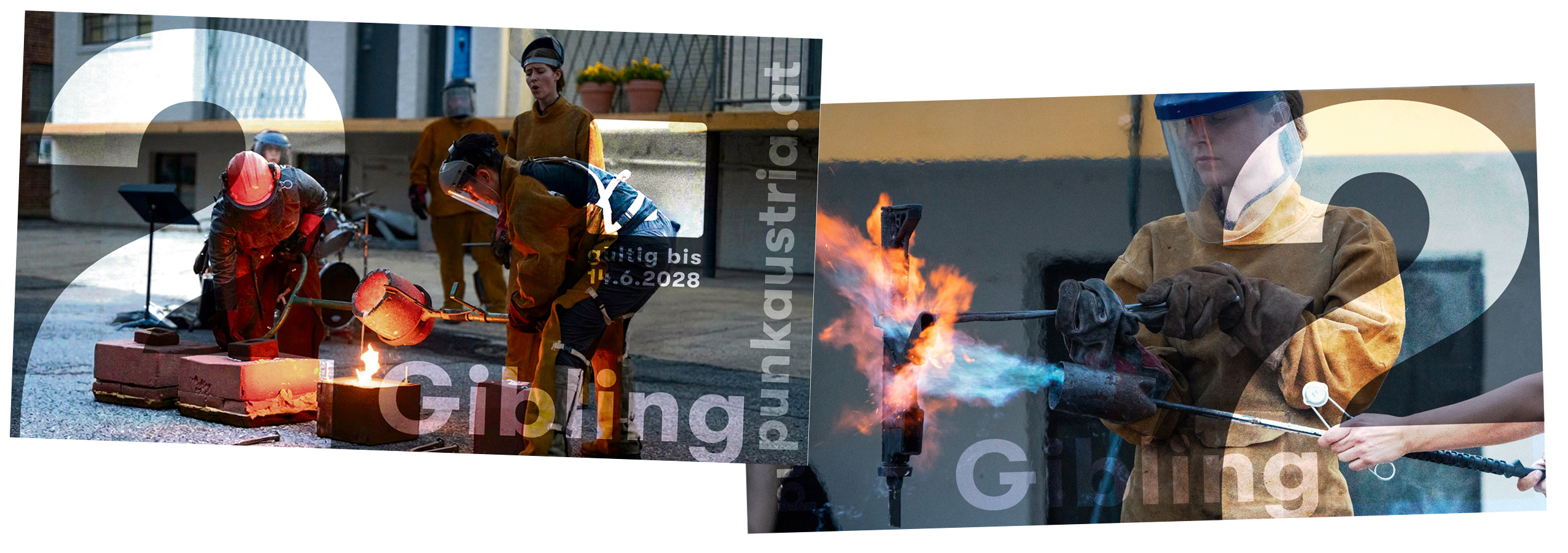
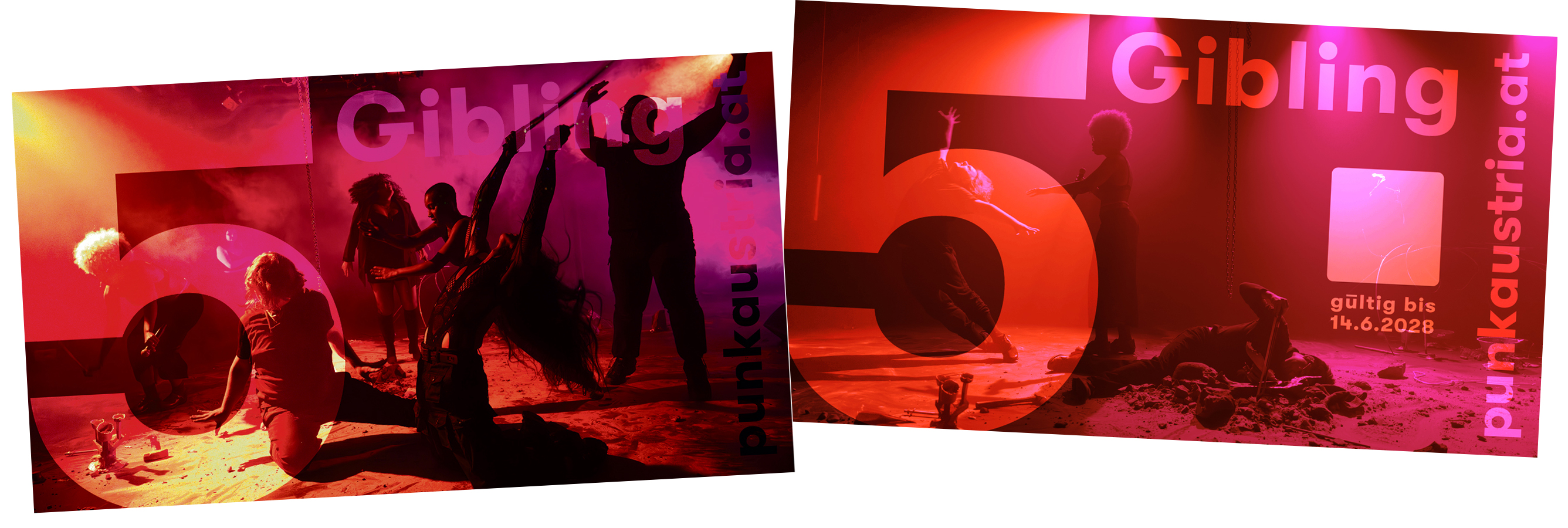
Heike Kaltenbrunner: Traditionally, banknotes feature motifs that are, or are intended to be, identity-forming, such as famous people or the bridges to be built on the euro notes. On the current Gibling, we see a process of transformation. A weapon is cut up, melted down, and transformed into a sound object. The image on the 2-euro note, in particular, where a firearm is being melted by a flame, is very powerful and potent. The process behind it, however, is deeply emotional—an act of mourning. Specifically, within the context of the opera “Never in Our Image,” from which this image is taken, the work mourns an attack on a queer nightclub. Many people lost their lives in that attack.
With regard to the opera performance in September, or even a later, larger-scale adaptation of the opera for Linz, the question arises: What are we mourning? For my part, I can say: I mourn the Holocaust, the arms race, the recent shift to the right in society, and the many femicides. That is why I find it significant to put these images—and thus the idea of transforming weapons—into circulation via the banknotes. Since the Giblings in our case are also announcing a performance in September and, at times, a broader project later on, they serve a similar function to flyers, which are also a mobile medium. Currency here also serves as a means of conveying information about the vast and urgent task of transforming violence.
Stephanie Mercedes: Unfortunately, guns are very easy to obtain in the U.S. Guns are a product sold to people. But what is actually being sold to them is fear. Weapons are very expensive. In the U.S., there is a loophole in inheritance law—for example, you don’t need the proper paperwork to own and pass on a weapon; in this respect, in the passing from hand to hand or even through inheritance, it closely resembles the direct transfer of money. Since my job essentially consists of destroying guns—that’s my work—I often come across really old rifles; especially those that have been passed down through generations. Sometimes they are beautiful works of art, but sometimes they have really poor accuracy and are very slow to reload.
But when I teach my students metalworking, I face a much more fundamental problem—for example, with an AR-15, a semi-automatic rifle. After all, the origins of metalworking lie in sacred objects, musical instruments, and weapons. On the one hand, weapons are merely tools. But on the other hand, it’s clear that weapons are a source— and weapons and art have gone hand in hand from the very beginning. And weapons are a mirror of society. I mean, I don’t think metal decided to become a weapon or an AR-15—we are the ones who decided to shape it into that form, which is deeply problematic. So ultimately, I think they’re just a reflection of our own problems..
II. RECLAIMING AS A STRATEGY: As part of the Gun Destruction Opera featured in the lectures, the material from firearms is used in a multi-stage process to compose music. To do this, these weapons must first be collected. How central is the imperative of reclaiming in order to, for example, deconstruct forms of use such as “steel becomes a weapon”? Or more precisely: How can new narratives be constructed from the reclaimed materials?
Stephanie Mercedes: How do you get your hands on weapons?
I answer the question differently, namely by viewing Gibling here as a reclaiming of a social structure. First, I present a very basic narrative related to social interaction. I was teaching with my materials in a kindergarten. A child asked: What if metal never wanted to be a weapon? And I found that really beautiful—because for many years I thought, I take this evil thing, I appropriate it, and transform it into this “beautiful” thing. And now I think that was perhaps a problematic thought process, because I shifted the blame onto the form. And in my work, I place form above humanity. Basically, I now view it as a process of reclamation: I try to work with metal in a way that gives it back its own agency and its own voice. Metal is a truly fascinating material—it literally comes into being when stars explode. It has this wild origin story and perhaps knows more than we do.
Heike Kaltenbrunner: I’m thinking of imperatives that have something powerful and resolute about them.
‘Lay down your arms!’ or ‘Destroy what destroys you!’ There’s something to that. But to be honest, I can’t think of a truly fitting and pointed imperative for this project yet. Because in Austria during the world wars, the path of materials went in the opposite direction: instruments were destroyed. Bells and organ pipes were melted down to make military equipment and ammunition. After the war came the Allies’ order to surrender weapons. We could build on that. “Now, finally, hand over that crap!” or “Throw your weapons in the recycling bin!” In the event that the performance is followed in the fall by a larger-scale adaptation of Stephanie’s opera for Upper Austria, a less combative language seems more appropriate to me—an open invitation to surrender weapons.
III. MULTI-STAGE TRANSFORMATION: The Opera has three acts in which the source material—the weapons—is first shredded, then melted down, and finally, new forms can emerge from the molten material. The Gibling offers the possibility of carrying out a multi-stage process of material processing; moreover, there are various denominations: 1, 2, 5, and 500. Are there parallels here in the transformation of weapons into sound and the creation of currency?
Heike Kaltenbrunner: I would see the parallel between Mercedes’ project and the Gibling more in the act of burning.
Stephanie Mercedes: A large part of the opera revolved around the deconstruction of sound—and the relationship between noise and sound. At first, I tried to create objects like bells, but then it dawned on me: What about the sound of my creative process itself? I work with power tools every day, and just as I’ve stripped metal of its power: angle grinders, a saw, the sound of the furnace, the sound of my blowtorches—all these things possess an astonishing sonic power. There’s no longer any difference in my work between noise and music. Perhaps there’s a parallel to currency in that the Gibling attempts to reexamine what currency actually is. You know, in my own work I also copyright all my contracts because they’re works of art too, and I find it interesting when currency is both useful and useless, because normally a work of art is useless, right? So I feel that the Gibling is very much trying to re-examine the separation between money and art—if there even is one—and the way people value currency. This idea of questioning seems to be the connection between the Gibling and the opera on weapons destruction. And for me personally, all of this in my sound and my operatic process is a truly queer process. I’m thinking about the queerization of materials—maybe the Gibling is queer too, or at least there’s a queer approach there.
IV. CULTURAL SIMILARITIES AND DIFFERENCES: Even though it’s not widely known, Austria has one of the highest densities of firearms in the world. In the U.S., gun ownership is even a fundamental right. And regarding money: It is generally considered state property. However, there are striking differences when it comes to destroying money—or let’s say, when I paint on a five-euro bill. In the U.S., destroying or altering banknotes is strictly prohibited, primarily to prevent fraud.
In Austria, you can do whatever you want with your money; it’s just that the National Bank won’t actually replace it if you destroy it. And it shouldn’t be more than €15,000 anyway. But now the question: Is currency art actually a seizure of power?
Heike Kaltenbrunner: Weapons and money are, unfortunately, the two most powerful threads in the tangles of the world order. Currency art is, in a sense, a seizure of power, yes. A tug on those threads.
V. GIBLING DESIGN: We’re excited about the new Gibling—how it looks, how it feels, how it spends. Perhaps you’d like to give us a glimpse into the process—how did the idea of depicting the Opera within the framework of the Gibling emerge from the opera itself? How did you work this out together, and what can be seen on the bills?
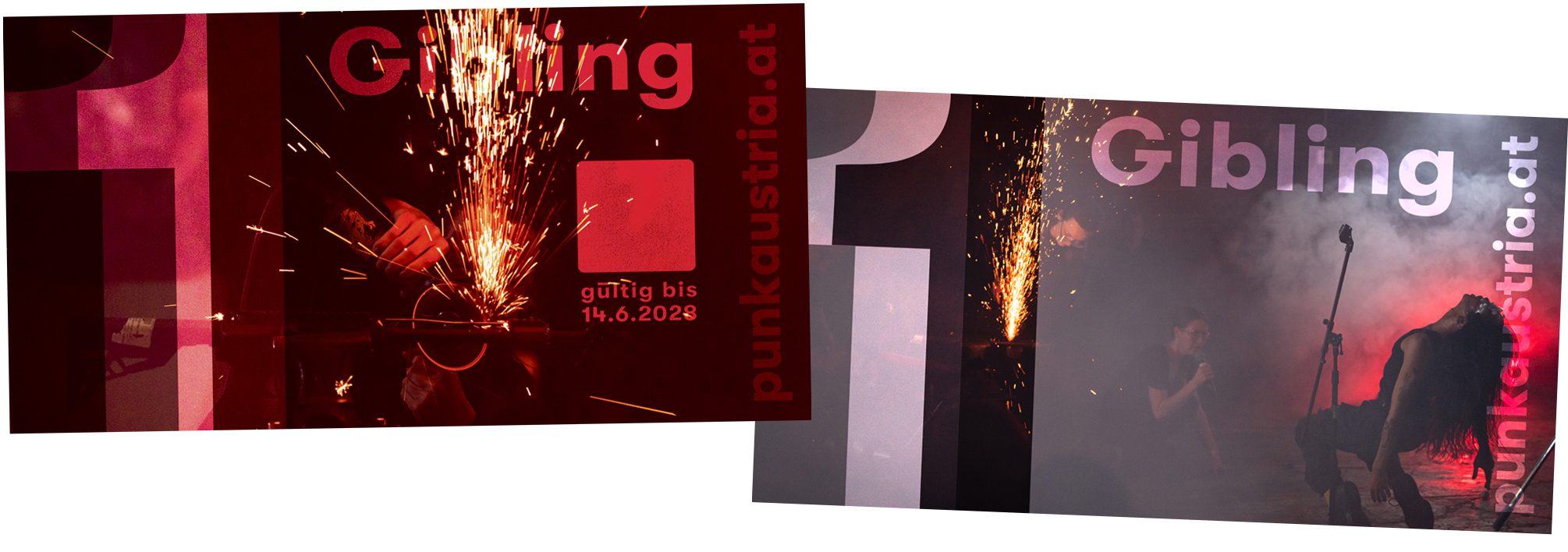
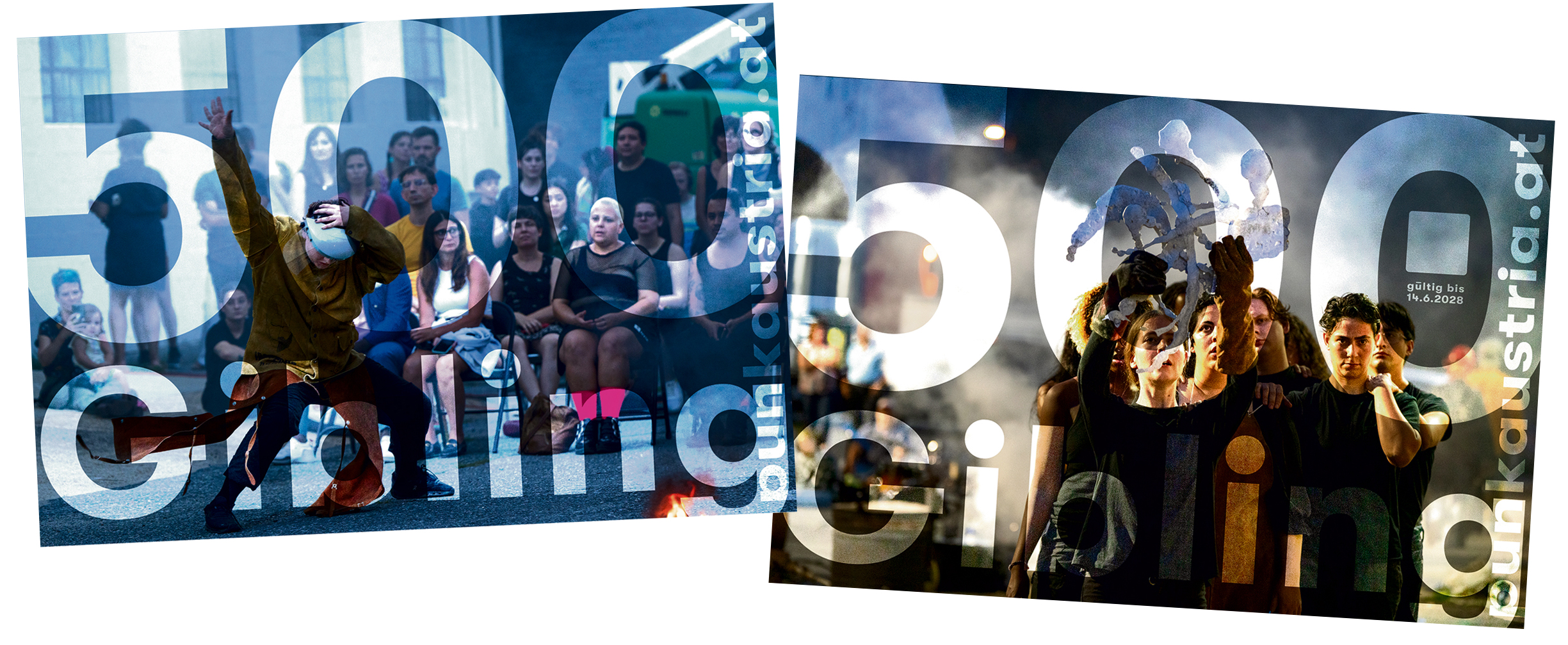
Heike Kaltenbrunner: On notes 1, 2, and 5, you can see scenes from the three acts of the opera. The same goes for the “large” note in the art edition, the 500-euro note. The idea came from Tanja Brandmayr. Stephanie selected the images; I did the typography. All in all, it was a very smooth collaboration.
Stephanie Mercedes: I’m very lucky to be working with the amazing photographer Amir Pourmand, who is now documenting my entire body of work and has captured these moments from the opera that felt truly radical. What does it mean to capture a one-hour piece with individual images? That’s crazy. I tried to send images from the different acts—there was supposed to be a certain kind of imagery on the currency. With some images, it might be hard to tell what’s happening. I tried to embody the opera as best as I could. Anyway, I sent the images and Heike turned them into a form of currency. Third act, a moment between three performers: I really wanted the third act to be about queer joy—the first act is queer grief, the second act is queer anger, which transitions into queer joy in the third act. And unfortunately, it’s really hard to create a work about joy. This is about Britney, Peter, and John. John plays the Flashing, this sculptural instrument made from melted-down weapons. It’s played with a violin bow, and Peter and Britney simply bring such great energy to the trio they’ve formed. Peter, the dancer, kept throwing himself to the floor. Britney sang; she has this very distinctive voice. It was a magical moment that captured the third act.
I’m really looking forward to the opera in Linz. I don’t really know yet what we’ll do; I think the important thing first is to bring queer performers together, then I’ll show up with the material and we’ll just decide what to do.
---
Edition No. 15 – GUN DESTRUCTION GIBLING
Edition No. 15, GUN DESTRUCTION GIBLING by Stephanie Mercedes and Heike Kaltenbrunner features scenes from the three-part queer weapon-destruction opera *NEVER IN OUR IMAGE*. In the opera, musical instruments and sound sculptures are crafted within the context of reclaiming weapons. Musical scores are composed through the cutting, melting, and use of instruments cast from weapons. Through the transformation of metal and sound, as well as the staging with a queer community, the fundamental question is posed: How can we reclaim ideas and objects that were never created in our image?
Gun Destruction Gibling “Never In Our Image”: Stephanie Mercedes || Visuals: Amir Pourmand || Graphics: Heike Kaltenbrunner || Linz performance of the opera in September 2026: Stephanie Mercedes, Heike Kaltenbrunner & Guests
Heike Kaltenbrunner is a sound and media artist. At the center of her artistic practice and research are object-based spatial and sound installations that create experimental spaces for encounter. Her points of reference range from the grand phenomena of the cosmos to human perception. Her works have been exhibited internationally, including at the Smithsonian Hirshhorn Museum, the ICMC, and at festivals such as Konfrontationen and Music Unlimited.
Stephanie Mercedes is an anti-disciplinary queer Latinx artist who works in the fields of sculpture, opera, techno, choreography, and sound. Her works revolve around the creation of rituals of mourning and liberation. Mercedes melts down weapons to craft instruments and sculptures, thereby unearthing repressed histories of violence. Mercedes has exhibited and presented performances at the Smithsonian, the National Gallery of Art, the Kennedy Center, the Bronx Museum, the Walters Museum, and the Art Museum of the Americas.
---
The GIBLING
Art as currency, currency as art: The Gibling is a community currency and art project of the STWST Banking Department Punkaustria. Each year, the banknotes of the community currency are redesigned by artists and issued by the STWST as an art edition. This means: The Gibling can be used as a real community currency in shops in Linz and beyond—and the underlying concept addresses themes such as value, loss, the market, speculation, and the economy, as well as the idea of money as a medium of exchange or as a system of domination.
All 15 Gibling editions and Gibling artists to date: Oona Valarie, 2012 | Leo Schatzl, 2013 | Deborah Sengl, 2014 | Michael Aschauer, 2015 | Judith Fegerl, 2016 | Julius Deutschbauer, 2017 | Eva Grün, 2018 | Peter Weibel, 2019 | OrtnerSchinko, 2020 | Shu Lea Cheang, 2021 | Franz Xaver, 2022 | Tina Kult, 2023 | Art Discount 24, 2024 | Kollektiv Herzblutwiese, 2025 | Stephanie Mercedes, Heike Kaltenbrunner, 2026
More info: Gibling, Artists, Community currency, List of all partner stores and exchange offices:
punkaustria.at, gibling.stwst.at