Currently in the making for the servus.at crew is the next edition of the community festival AMRO (Arts Meets Radical Openness). The festival will take place from 13th to 16th May at the afo – architekturforum oberösterreich, Stadtwerkstatt, MAERZ Gallery and the Kunstuniversität Linz, as well as a few independent locations across the city centre, including BB15 – Space for Contemporary Art, /dev/lol, DH5, Willy*Fred and Raumschiff.
Titled ‘Becoming Unreadable’, the upcoming edition of AMRO invites its community to reflect on and engage with the concepts of invisibility, unreadability, ungovernability, and uncomputability in the current techno-political moment, which is dominated by AI and the strengthening alliance between big tech and conservative politics. For AMRO, becoming unreadable is a strategy to react to tendencies and philosophies connecting digital networks, labour dynamics, political discourse, social spheres, the economy and much else currently perceived as part of an interconnected crisis. In its call for participation, AMRO refers to this as the ‘toxic dimensions of contemporary hyper-visibility’, a term which is not yet widely used in critical discourse, but which can be useful for reflecting on the relationship between vision (meaning mostly computational vision) and how visibility and being seen have become central features of social and political dynamics. The festival asks what the consequences of such tendencies are for society and individuals, and envisages radical forms of media arts discourse and practices grounded in a logic other than the accumulation of data, computing power and wealth. Perhaps these could offer a basis for refusing hyper-visibility through privacy and digital self-determination.
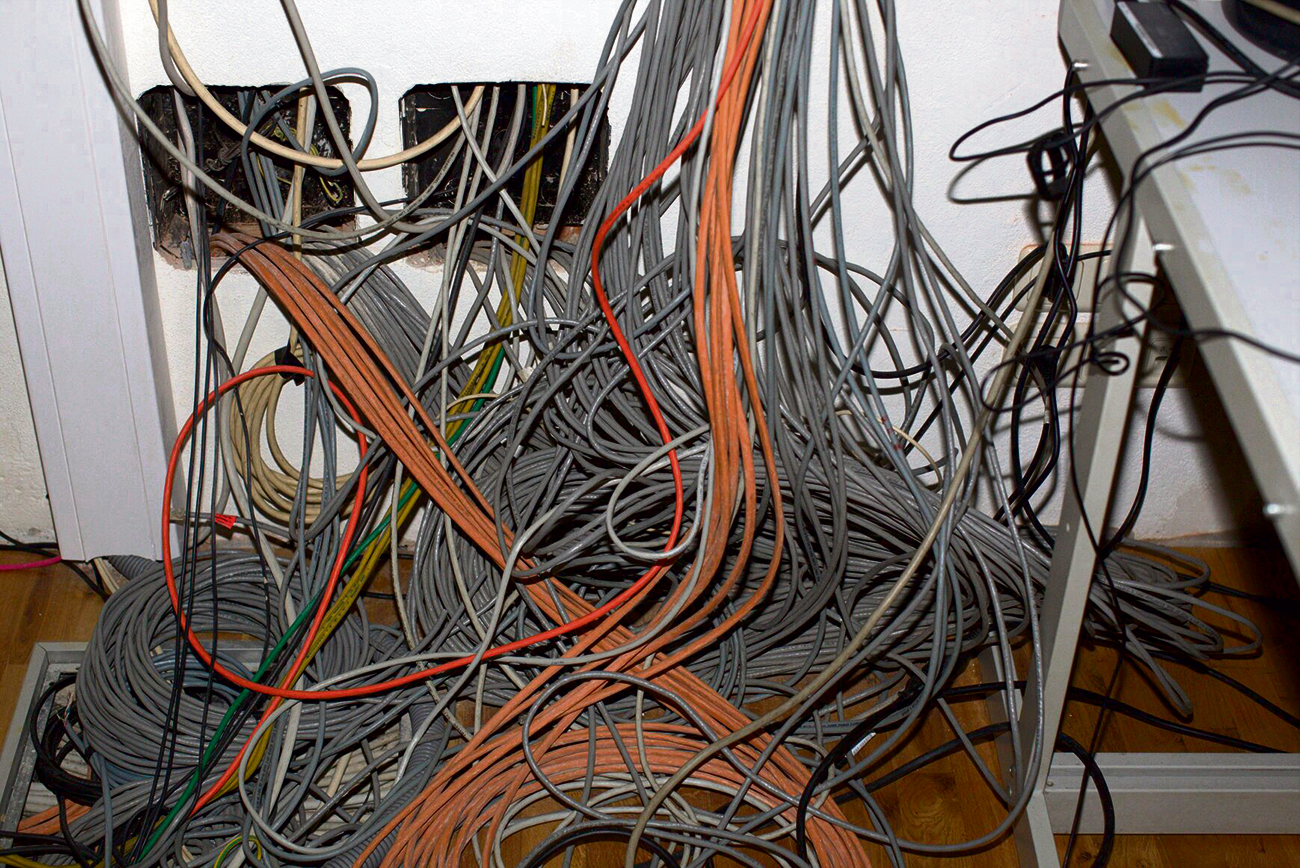
Image from the self-maintained datacenter at servus.at (Bild: Sophie Morelli)
A first read on visibility and being visible is a sociocultural one, dealing with the effects of social media platform dependencies. This has been arguably always important in cultural work, politics and economy, which are fields where being present and being recognized play a role in succeeding – or not. Visibility (or coolness) has often formed a ground for social capital. The past decades of social network platform dominance, however, strengthened so much the equation of being visible with being successful, that non-engagement in that game is now almost unthinkable, also outside strictly professional needs. This is not only a form of computer-aided vanity or algorithmic egocentrism that slowly erodes the social cohesion because everyone only thinks for themselves. The pervasive logic of self-narration, authenticity, and self-made-ness has reached a point where mediated representation is fully integrated with action. In the 2023 Research Lab on platform labour and interveillance dynamics, we observed several variations of the theme of surveilled labour with S()fia Braga, in which, when one only exists while streaming, one can no longer exist without the big tech corporate platform for streaming. Performed on a global scale, this renders the social and political unthinkable outside of proprietary spaces such as Facebook and Instagram. Due to the relative ease of adoption and low operational costs, we have forgotten how to plan and trust things to work outside these digital architectures, something that we need to restructure and relearn. AMRO and Servus have addressed this issue in various formats in which we have participated over the years, including the Cloud Clinic, #endof10 and Digital Depletion Strikes, to name a few.
The global-scale psyop masterpiece that convinced humanity to voluntarily hand over all their data to the machine is closely linked to the other layer of visibility that AMRO considers: the extractive vision that powers AI. Almost 10 years ago, Vladan Joler and Kate Crawford summarised this in their concept of ‘new extractivism’, whereby data collection is fundamentally coupled with the material excavation of rare earths to create new GPUs. Together, they reach »the furthest corners of the biosphere and the deepest layers of human cognitive and affective being« (https://anatomyof.ai/, 2018). Vision also means control through concepts and metaphors. In her 2021 »Atlas of AI«, Crawford effectively describes AI as the new logic that reorganises the entire global production system through a common paradigm. Maybe it did not feel that concrete back then, but just a few years later, we can see how entire economic sectors have now reorientated towards the AI rush. Rare earths, copper and lithium are becoming geopolitically increasingly relevant. The majority of hardware and software ecosystems have turned to AI, following investments and the promise of revenue. Finally, the sheer volume of exploitative human labour involved in data labelling, content moderation, and overseeing machines continues to expand as the forced adoption of LLMs and chatbots becomes increasingly pervasive.
»The field of AI is explicitly attempting to capture the planet in a computationally legible form. This is not a metaphor so much as the industry’s direct ambition. The AI industry is making […] a centralized God’s-eye view of human movement, communication, and labor. Some AI scientists have stated their desire to capture the world and to supersede other forms of knowing.« (Crawford, 2021)
Many people just want to be able to hide from this totalitarian ideology, perhaps by following the tips from Hito Steyerl in How Not to Be Seen: A Fucking Didactic Educational .MOV File (2013). This video work focuses on evading surveillance by hiding within the vast amount of images being created and circulated, and on the idea of people turning into images. In the age of AI, the number of images available has grown exponentially, with synthetic representations completely replacing real people. This does not guarantee invisibility, as Steyerl discovered when she prompted Stable Diffusion to generate an image of herself, the result being an inaccurate and racist depiction of the artist. (see: Hito Steyerl »Mean Images« in NLR 140/141, March–June 20231).
What AMRO wants to discuss is how to envisage possible ways out, both technically and, most importantly, culturally. The point is not to try to become literally invisible by avoiding having our images go online. The machine will always claim that it can represent us, and misrepresentation can easily be justified as a hallucination or countered with the argument: »We need more images of you to be faithful«. The idea that we need more data and more computing power to make the machine work better has already been proven wrong a number of times, yet it remains deeply rooted in our understanding of technology. Becoming invisible or unreadable is an attempt to question the feeling that we have no alternatives to planetary-scale networks, extraction, and the forced adoption of algorithmic logic to regulate social and political aspects of life.
At our community festival, we therefore want to discuss the possibilities of refusal and resistance: how can we avoid being forcefully or manipulatively extracted from our identities, data, ideas, and work? Not being included in training datasets can be seen as a cultural and political act that aims to prevent us from giving up our representation and that of our work to a statistical machine.
Furthermore, given that major corporations dealing with AI have ruthlessly exploited all publicly accessible content on the web, we must reconsider what it means to publish and make things public online. At this point we should finally accept that the promise of reaching everyone online is mostly unrealistic or undesirable, and that joining large corporate networks will not automatically increase the visibility of our thoughts.
Therefore, in the age of AI scraping, the concept of public access must be reconsidered. This involves creating strategies to hide from the all-seeing eye of the machine and adopting measures to make our data and products inaccessible to AI data collection. One simple measure would be to lock web content behind a login, requiring readers to register and log in, thereby regulating access but potentially losing part of the casual audience browsing the web.
One interesting strategy to avoid such login walls is to implement systems of AI sabotage, i.e. software that can tell whether a page is being fetched by an AI scraper or a regular user. A comprehensive list has been published by the Algorithmic Sabotage Research Group2, an activist collective that is heavily involved in conceptualising and developing counter-technological practices. Their list, »Sabotage in the Age of AI«, features a series of server-side tools that analyse web server requests. Where the software detects that the client is a potential AI scraper, it automatically delivers content to confuse the spider, trapping it in an endless series of nonsense articles and rendering their collection useless. The software can also try to poison the data and disrupt the training process by delivering carefully developed data artefacts that aim to break or halt computing processes.
Nevertheless, technical implementations cannot solve the problem alone; they require much wider awareness and discussion of autonomy, digital independence, and the deconstruction of computational habits and the unreflective use of digital resources. They also require an approach to digital technologies that is truly ethics-oriented. This is also a theme that has developed across AMRO editions, which focus on permacomputing practices and, more broadly, community-oriented digital infrastructures3. Such works reconnect the technological with the social, offering the potential to disengage from exploitative digital networks and reimagine computation as a collective endeavour.
==
==
Art Meets Radical Openness 2026
Becoming Unreadable
13th-16th May 2026
13th May: festival opening at afo - architekturforum oberösterreich
14th–16th May: lectures, workshops, performances, nightline in afo - architekturforum oberösterreich, Stadtwerkstatt Linz, MAERZ galerie, SPLACE, bb15 – space for contemporary art.
Full program and registration links will be available mid April at https://radical-openness.org